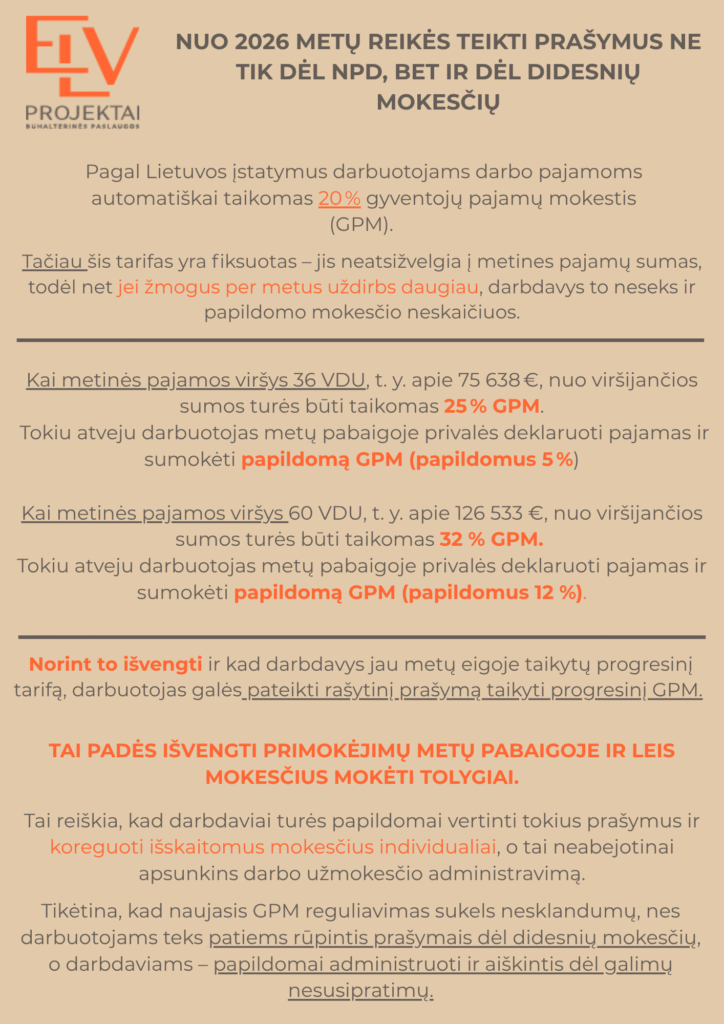
From 2026, you will need to provide not only for NPD, but also for higher taxes
Under Lithuanian law, employees are automatically subject to a 20% personal income tax (PIT) on employment income.
However, the rate is fixed – it doesn’t take into account annual income, so even if you earn more in a year, your employer won’t follow suit and won’t charge you any extra tax.
When the annual income exceeds 60 GVA, i.e. around €126,533, a 32% GPT will be charged on the excess . In this case, the employee will be required to declare the income at the end of the year and pay an additional GPT (additional 12%).
When the annual income exceeds 36 GVA, i.e. around €75,638, a 25% GPT will be due on the excess. In this case, the employee will have to declare the income at the end of the year and will have to pay an additional GPT (additional 5%)
To avoid this, and to ensure that the employer applies the progressive rate already during the year, the employee will be able to submit a written request for the application of the progressive rate of GPT.
This will help avoid overpayments at the end of the year and allow you to pay taxes evenly.
This means that employers will have to make additional assessments of such claims and adjust withholding taxes on an individual basis, which will undoubtedly complicate payroll administration.
The new GST rules are likely to cause problems, as employees will have to deal with higher tax claims themselves and employers will have to deal with additional administration and clarification of potential misunderstandings.